
Simon Rohou

Autonomous underwater robotics

Underwater exploration · Set-membership methods

I work on autonomous underwater robotics, particularly localization, navigation and exploration under uncertainty. These challenges motivate my research in interval analysis and set-membership estimation. In turn, advances in these methods provide new tools for tackling difficult robotics problems, with explicit uncertainty bounds and mathematical guarantees when the assumptions allow them.

Research

Underwater robotics & exploration

My research addresses localization, state estimation and SLAM for autonomous underwater robots. Since GNSS signals do not propagate underwater, navigation relies on onboard sensors and often incomplete observations of the environment. Drift, ambiguities in sonar measurements and uncertain oceanographic conditions make it difficult to determine where a vehicle actually is.

I study navigation approaches that exploit the constraints provided by vehicle dynamics, acoustic measurements and the seabed itself. This includes terrain-based navigation, sonar-based localization and the estimation of trajectories when initial position or heading is poorly known. Set-membership methods are particularly useful when several locations remain possible and none should be discarded prematurely.

A current objective is to transfer these developments to compact micro-AUVs through the Yodac program. Polar and under-ice missions provide a demanding test case: magnetic heading may be unreliable, surfacing may be impossible, currents and tides are imperfectly known, and the robot must still find its recovery point. These constraints motivate research on reliable navigation, exploration coverage and safe return.
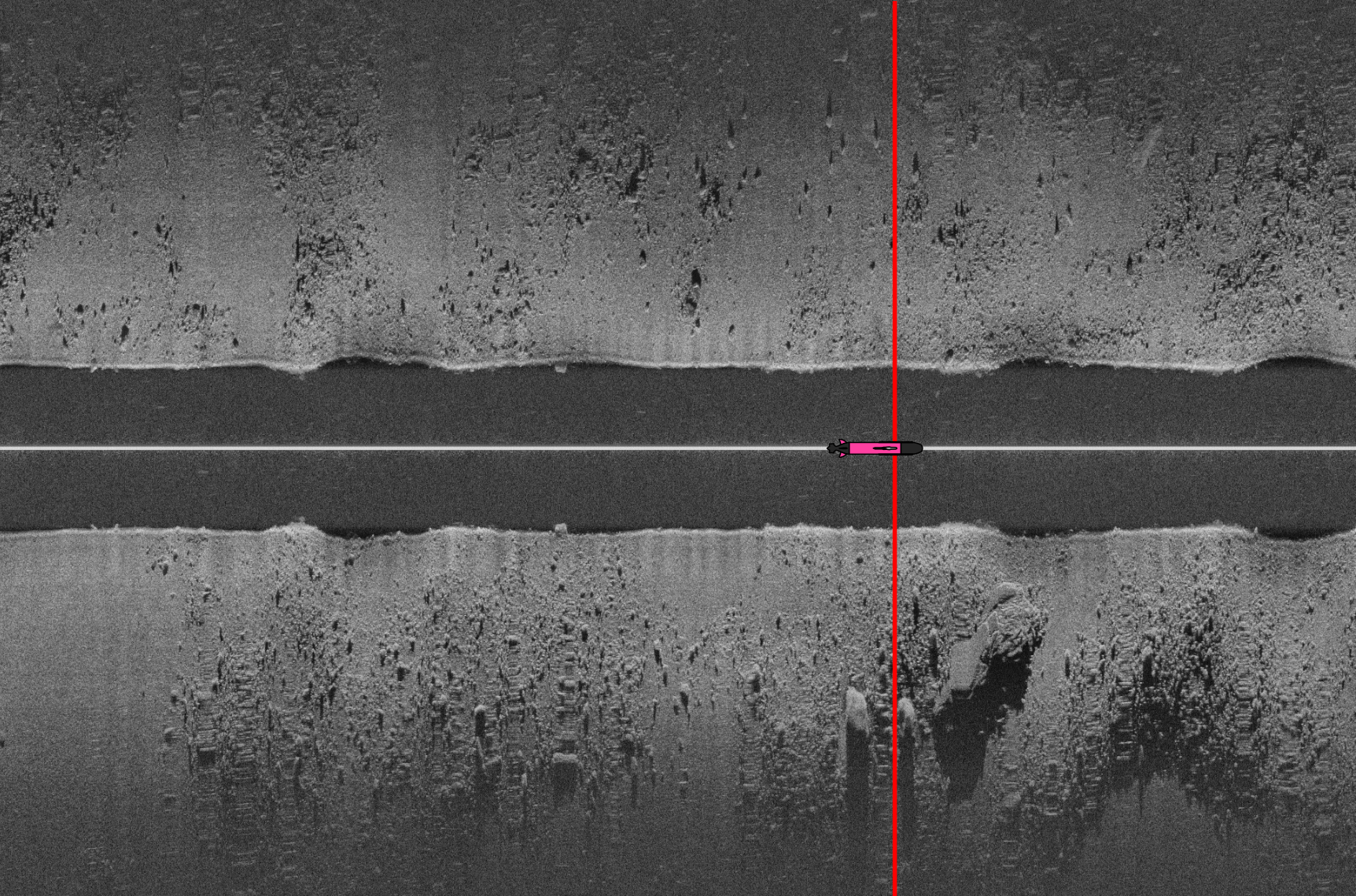
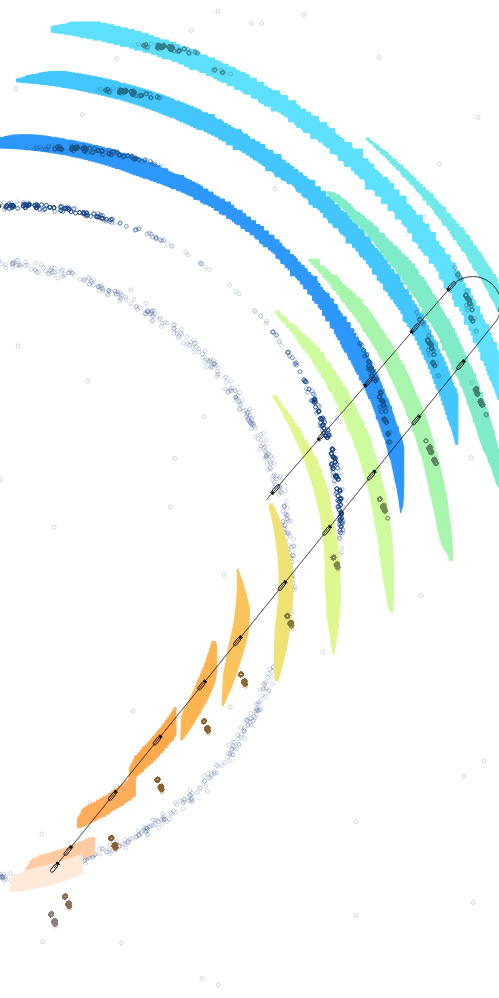
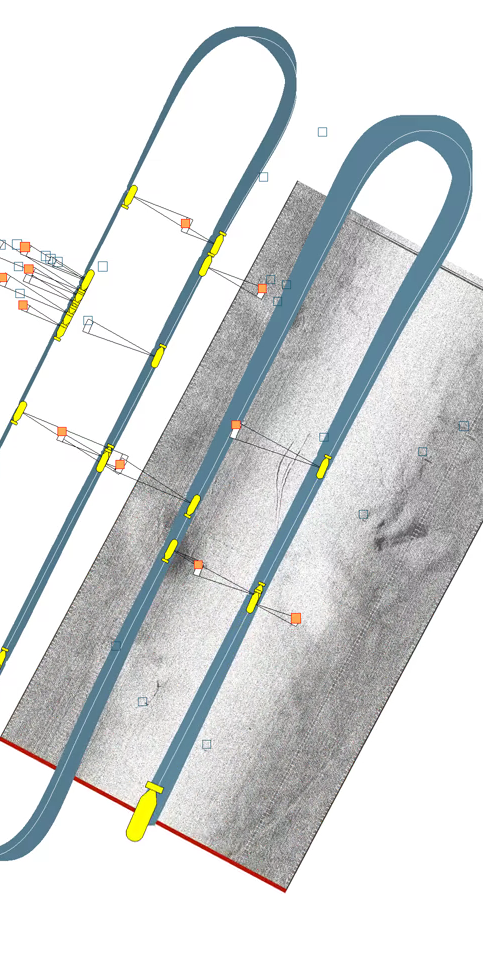
Side-scan sonar acquired from an autonomous underwater vehicle (LEMAR)
Side-scan sonar survey by an AUV (LEMAR)
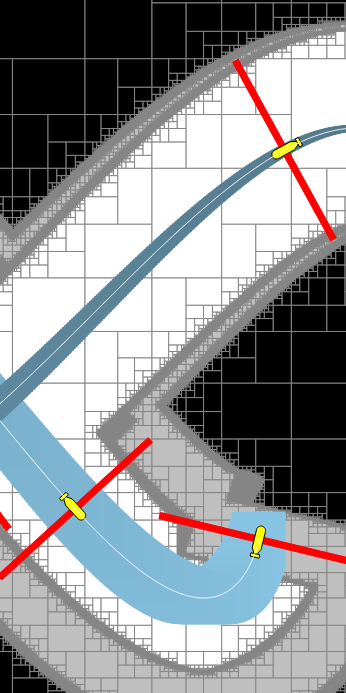
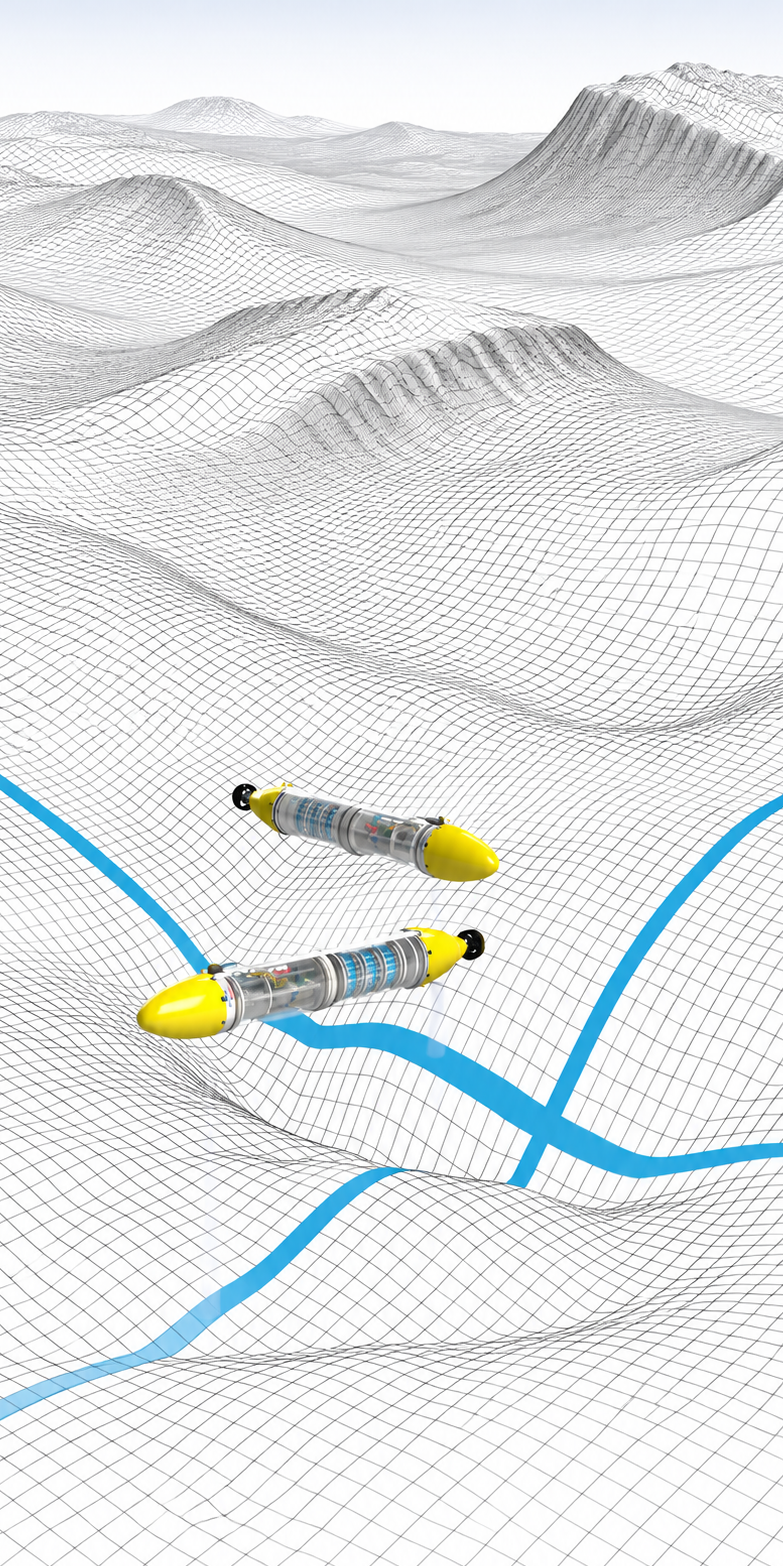
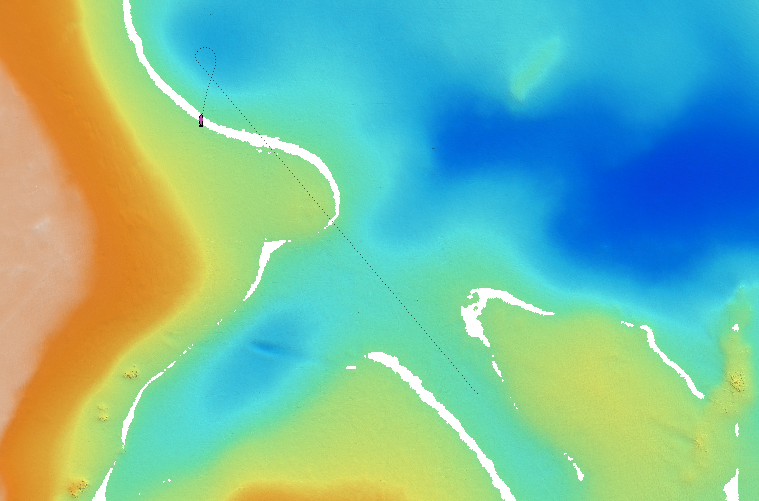
Terrain-based robot localization on a bathymetric map
Terrain-based localization
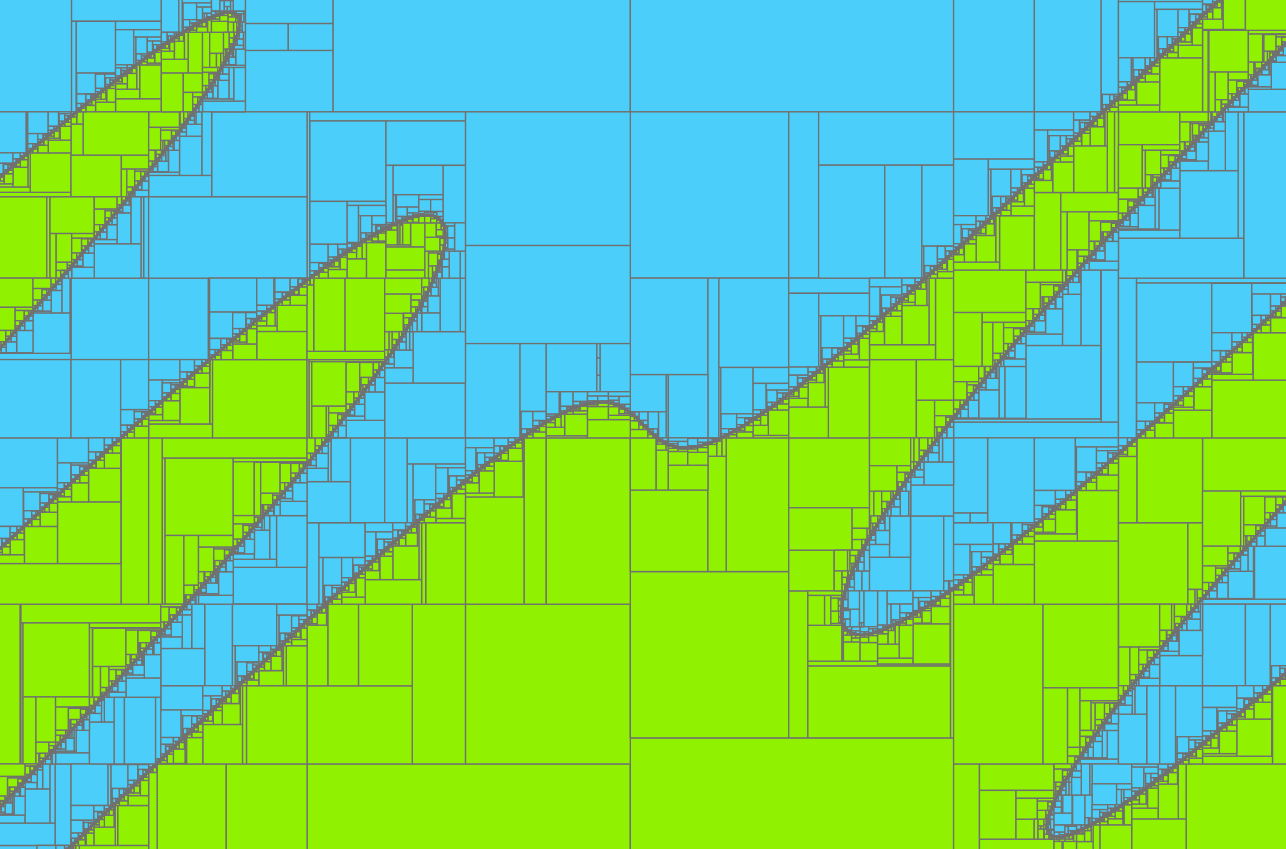
Set inversion with Codac shown as a blue and green paving
Set inversion with Codac
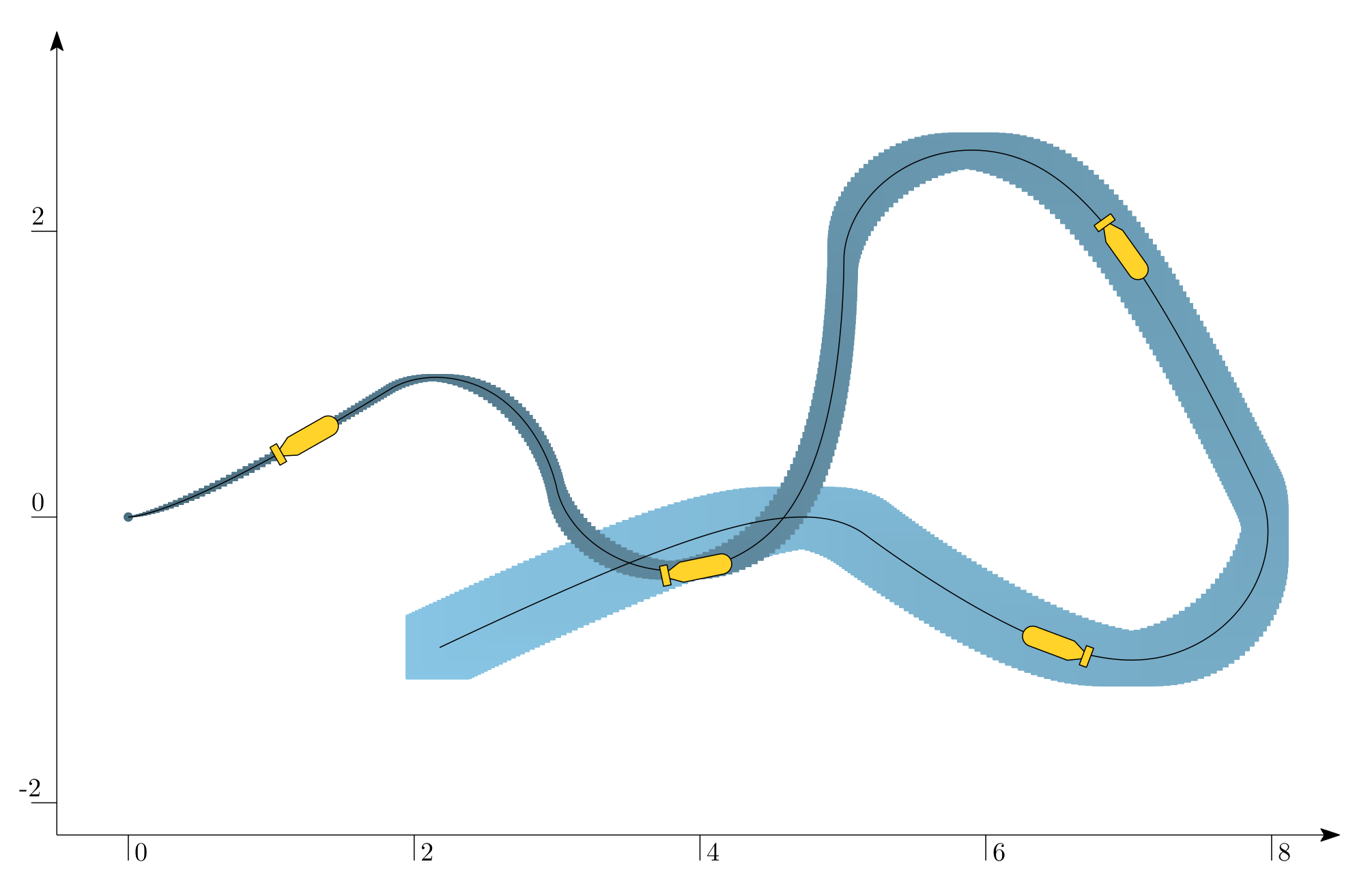
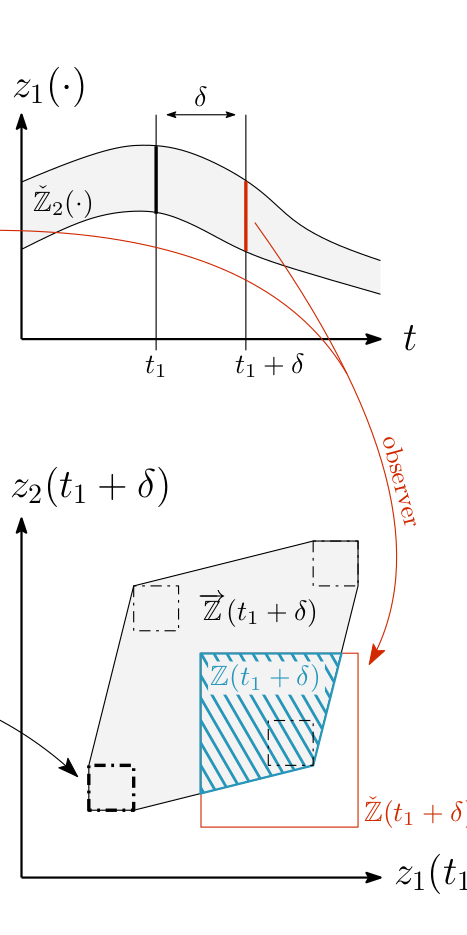
Uncertain robot loop represented by a trajectory tube
Uncertain loop enclosed by a trajectory tube

Set-membership methods & interval analysis

My methodological work concerns interval analysis and constraint programming for nonlinear systems. Instead of computing only a best estimate, set-membership approaches seek to enclose all solutions consistent with stated uncertainty bounds. They therefore preserve ambiguities and provide guarantees of inclusion, provided the models and measurement bounds are valid.

I develop numerical operators such as contractors and separators to propagate information through equations, inequalities and dynamical models. A recurring theme is the treatment of trajectories and time-dependent constraints, with applications to state estimation, data association, shape registration and guaranteed reasoning about robot motion. Recent work on Contractor Filters explores how such operators can support online estimation.

These ideas are developed in Codac, an open-source C++/Python/Matlab library that I lead. The software serves both as a research platform for new interval algorithms and as a way to apply them to real robotics problems. In turn, the limits encountered during underwater experiments guide the development of new mathematical tools.

Codac website ↗

Publications (20)

  1. Illustration for Contractor Filters

    Contractor Filters

    Simon Rohou

    Submitted to Robotics and Autonomous Systems · 2026

    This paper introduces Contractor Filters, a set-membership filtering framework for nonlinear continuous-time systems with bounded uncertainty and occasional outliers. Feasible states are represented through compositions of contractors, separating the filtering equations from a particular geometric representation. Experiments in range-only and terrain-based localization examine ambiguity, robustness and the trade-off between computational effort and enclosure tightness.

  2. Mechatronics · 2025
  3. Illustration for The Codac library: a Catalog Of Domains And Contractors

    The Codac library: a Catalog Of Domains And Contractors

    Simon Rohou, Benoît Desrochers, Fabrice Le Bars

    This article introduces Codac, a library for interval computations and constraint programming over real-valued variables, trajectories and sets. It describes the contractor-network approach, in which constraints are propagated to reduce the domains of possible solutions without excluding feasible values. A robotic example illustrates how these tools can be assembled for state-estimation problems.

  4. Illustration for Brunovsky decomposition for dynamic interval localization

    Brunovsky decomposition for dynamic interval localization

    Simon Rohou, Luc Jaulin

    This article proposes a set-membership trajectory estimator when the initial robot state is entirely unknown and the observations are nonlinear. A symbolic Brunovsky decomposition separates the dynamic model into algebraic constraints and chains of integrators, which can then be handled by dedicated contractors. The method is illustrated on a challenging robot-localization problem without prior state information.

  5. Auguste Bourgois, Simon Rohou, Luc Jaulin, Andreas Rauh
    MDPI · 2022
  6. Automatica · 2022
  7. Illustration for Set-membership state estimation by solving data association

    Set-membership state estimation by solving data association

    Simon Rohou, Benoît Desrochers, Luc Jaulin

    This work considers robot localization when observations cannot be associated uniquely with landmarks and the initial position is unknown. A deterministic set-membership formulation tackles data association and state estimation jointly, avoiding an explicit enumeration of all possible associations. The method is demonstrated with data from an underwater robot equipped with sonar.

  8. Book published at ISTE Group · 2019
  9. Illustration for Proving the existence of loops in robot trajectories

    Proving the existence of loops in robot trajectories

    Simon Rohou, Peter Franek, Clément Aubry, Luc Jaulin

    A robot may revisit an area even when its uncertain trajectory does not allow a conventional loop-closure test. This paper uses topological degree and bounded-error trajectory descriptions to prove that a loop occurred using proprioceptive measurements alone. The method is studied mathematically and illustrated with real autonomous underwater vehicle data.

  10. Automatica · 2018

Selected projects

The following research projects connect the development of reliable numerical methods with their evaluation on autonomous systems. Some focus on underwater perception and navigation, others on algorithms for uncertain dynamical systems. Together, they support a progression from mathematical methods to experiments with real robots.

MARLIN

2027– RAPID (AID)

Autonomous underwater relocalization and inspection

MARLIN, developed with IVM Technologies, addresses reliable relocalization and autonomous underwater inspection. It combines acoustic, visual and inertial measurements to revisit previously mapped sites or objects despite navigation drift and limited visibility.

The project develops terrain-referenced navigation, multimodal matching and onboard hybrid SLAM, together with autonomous photogrammetric inspection and high-resolution 3D reconstruction of underwater structures.

FAUV

2026– CIMO (Institut Polytechnique de Paris)

Onboard SLAM for micro-AUVs

FAUV focuses on onboard simultaneous localization and mapping (SLAM) for micro-AUVs, whose limited sensors and computing resources complicate navigation. Without underwater GNSS, drift must be corrected using environmental observations.

The project develops set-membership SLAM methods suitable for onboard execution, combining reliable estimation algorithms with experimental validation on compact underwater vehicles.

CORMORAN

2027– ASTRID (AID)

On-demand seabed mapping with micro-AUVs

Developed with LEMAR, CORMORAN aims to map and characterize seabeds on demand using micro-AUVs equipped with side-scan sonar. It investigates guaranteed localization from an acoustic reference carried by a potentially drifting support vessel, avoiding a fixed underwater positioning infrastructure.

The project combines certified exploration coverage, onboard replanning and sonar-based seabed classification, with post-processing to improve georeferencing. Experiments progress from Brest to Saint-Pierre-et-Miquelon and the polar waters of Terre Adélie.

GPA2M

2023–2025 AID

Geopositioning by landmarks in the maritime environment

GPA2M studies marine geopositioning from angular measurements (goniometry) of environmental landmarks when GNSS is unavailable or unreliable. Direction measurements constrain the vehicle position, even when landmarks cannot always be identified unambiguously.

The project addresses bearing-only localization with uncertain heading, measurement errors and ambiguous landmark associations. Set-membership methods help retain multiple feasible positions while combining angular observations collected over time.

Electro-Karst

2022–2026 ANR (ANR-22-CE33-0005)

Robot exploration and mapping of karst networks

Electro-Karst develops robotic methods for exploring confined, flooded karst networks, where access and observation are difficult and irregular geometry challenges conventional navigation.

Research includes articulated robot locomotion, electric-sense perception and SLAM based on acoustic and electric measurements. These confined environments demand perception methods that work with limited visibility and without conventional maps.

CONTREDO

2016–2020 ANR (ANR-16-CE33-0024)

Intervals and contractors for dynamical systems

CONTREDO investigated constraint programming for dynamical systems under bounded uncertainty, combining differential equations, uncertain measurements and trajectory constraints within a numerical framework.

Its research on interval tubes and contractors contributed to guaranteed constraint propagation over time, including constraints linking measurements at different instants, and laid foundations for later work in Codac.

Background & activities

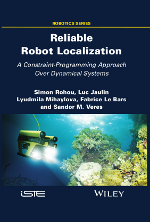
Cover of the ISTE book Reliable Robot Localization

PhD thesis

Reliable robot localization: a constraint-programming approach over dynamical systems.
Joint French–British PhD between ENSTA Bretagne / Lab-STICC and the University of Sheffield, defended on 11 December 2017. My research was supervised by Luc Jaulin and Fabrice Le Bars in Brest, together with Lyudmila Mihaylova and Sandor M. Veres in Sheffield. It was funded by the French DGA through the Franco-British doctoral programme.

The thesis develops interval-based constraint propagation methods for reliably estimating robot trajectories and demonstrates them on underwater localization problems. It was published as a book by ISTE / Wiley in 2019.

2017 Best PhD Thesis Award from the French GdR Robotique (CNRS).

GdR Robotique

GdR Robotique (CNRS)

From 2020 to 2025, I coordinated the Marine and Underwater Robotics working group within the French national GdR Robotique. The group brings together researchers working on autonomous surface and underwater vehicles, including perception and localization, control, communication, coordination, onboard autonomy and experimental technologies.

A central objective was to encourage exchanges between laboratories and industrial partners through scientific seminars, discussion of current research challenges and identification of opportunities for collaboration. The programmes of the seminars I organized are archived below.

Set4MOST winter and spring schools

Set4MOST winter and spring schools

I have participated in the organization of Set4MOST, a series of scientific schools dedicated to Modelling, Estimation, and Control using Set-Based Methods: Theory and Applications. The courses introduce interval and set-based approaches, covering parameter identification, state estimation, robust control and numerical verification of dynamical systems.

These schools combine lectures and practical sessions delivered by researchers active in the field, mainly for PhD students and early-career researchers. The series began in Lille in February 2024 and continued with a spring school in Oldenburg in April 2026.

Public lectures

In October 2019, I gave an informal public lecture in flip-flops entitled Underwater exploration techniques: history and innovations at the Festival Baie des Sciences in Saint-Brieuc, France. The talk, in French, presents the development of underwater exploration methods and the technological challenges of autonomous robotic vehicles.

Students, talks & academic archives →